
The classroom as a performance space – what research tells us
Updated: 3 days ago
IN THE CLASSROOM
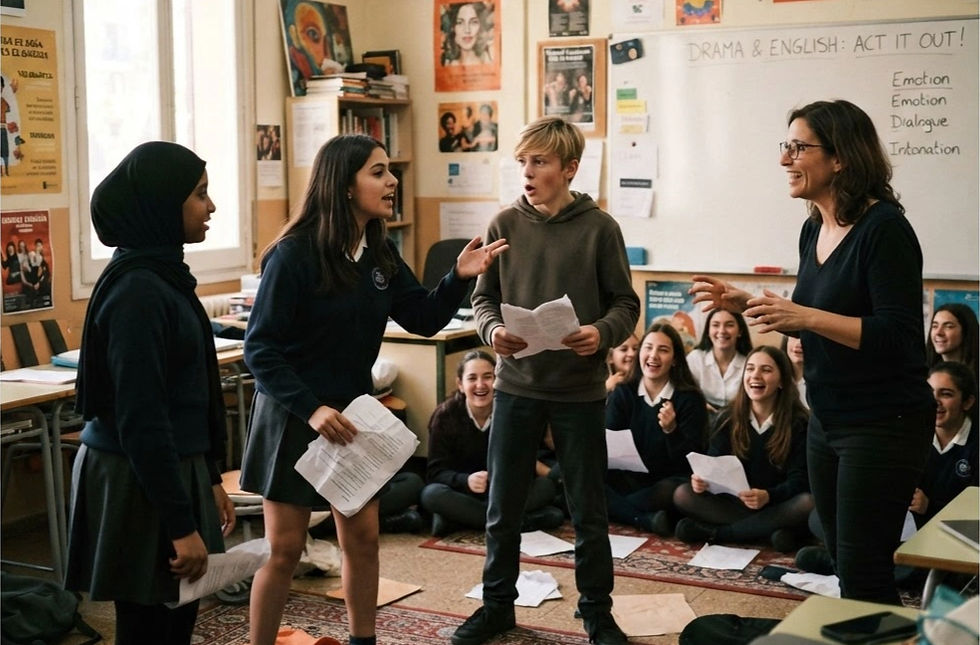
Teaching spaces remain largely inherited from the 19th century, when school architecture was designed for transmission and surveillance rather than interaction. At Drama Ties, we address this issue and use the classroom space differently, or when possible, take language learning into a bigger, open space. Today we know that meaning emerges from movement. Getting students to stand up and move around is extremely important, but we are also looking at a movement of consciousness: the encounter between what they perceive, what they imagine, what they experience and what they understand. For this, emotions play a significant role. Neuroscience confirms that cognitive and emotional processes share the same sensorimotor circuits as language learning. Learning a language is therefore inseparable from emotions. The more we can make our students feel, the deeper the understanding. Of course, some of these emotions may be negative, including anger and anxiety, and this is where theatre can provide a safe space for students to navigate these emotions: inventing and performing a role, a character different to yourself, creates a shield to protect your inner self and yet still provide the possibility to delve into one’s emotions. As the theatre-maker Peter Brook writes: "In everyday life, 'as if' is an escape; in theatre, 'as if' is the truth."
The biggest difference from everyday English class the way the workload is organized and put into place: the work is no longer to be handed in, but rather a situation to be experienced. In a traditional language class, students can often feel little connection to a discourse that they reproduce without truly understanding it - the foreign language becomes an external object rather than a space for experience. Our research projects are tackling this issue by inviting the students to create their own personal connections to a foreign language, and exploring their own individual processes of discovery and learning.
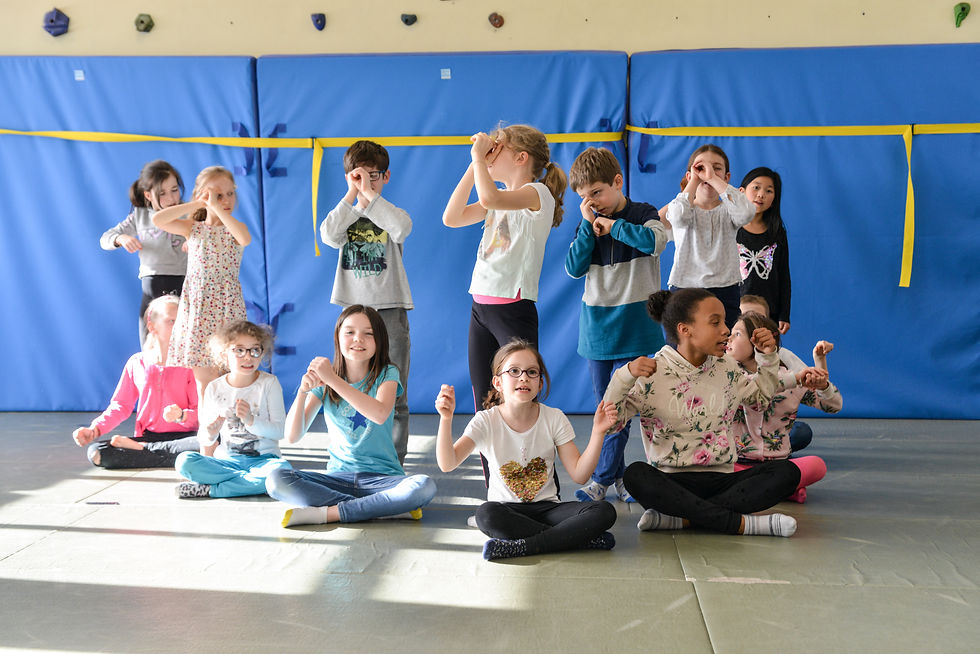
Science has taught us that language learning is a coupling of perception and action. Drama techniques offer activities in which meaning is formed, and transformed, through the way we use out bodies in different spaces, as well as our voices and our emotions. This gives our students greater intentions for the actions they do, and the things that say, which profoundly transforms didactic objectives. A student is not saying “how are you today” because it was on their list of vocabulary to learn for homework, but because they are exploring a situation physically which arouses their curiosity and perception, so upon noticing a particular emotion in a classmate (either personal, or playing a role) their intention when asking “how are you today” comes from an intimate connection to the language, transforming the way they retain the newly learnt words. Linguistic knowledge remains essential, but it is rooted in an experience of shared otherness that is interdependent with the spaces in which they work.

MULTILINGUAL STUDENTS
Today more and more students have multi-cultural roots. Performances in a foreign language inevitably draw on the pupils' first languages, whether they be family or social languages. These languages form the foundation from which new speech emerges. From a multilingual perspective, these languages are not obstacles but resources. Performance creates a space where languages coexist, intermingle and respond to each other. It transforms perception into action and action into speech, but today we see that many students refrain from using their family languages as a way to discover a new language and, instead pressure themselves to learn passing from one foreign language (French) to foreign language (English), which unsurprisingly, results in a lack of emotional attachment to the learning process. Our performance-based research encourages students to use any and all language skills (Arabic, Mandarin, Italian…) that they may already have, in order to find their own path to learning a new language: English.
CURRENT RESEARCH
The CELAVIE study (Université Aix-Marseille S. Eschenauer) in place since 2022 aims are to examine, in an ecological classroom context, the impact of a performative approach on communication skills in foreign languages, taking into account its physical, psychosocial and linguistic components. The study also aims to understand how the spaces involved (intimate, material and scenic) transform students' communication behaviors. The first phase of the experiment was conducted over two years with Cycle 3 pupils (CM1-CM2) in two geographically close schools with comparable profiles. One of the classes constituted the test group and engaged in a theatrical performance approach to language learning, and the other class constituted an active control group who followed a board game programme in English. The data was collected based on different types of interviews, a language test developed for the study, as well as electroencephalography to measure patterns of the brain activity. Both the qualitative and quantitative data from this project so far show a positive effect of the performative approach on the development of language skills, but also psychosocial skills (empathy and creativity). Cross-analysis of the corpus confirms a circular relationship between space, movement, emotions and speech in a foreign language.
The ARISE study (Université Aix-Marseille J. Bongiorno, S. Eschenauer, C.Tardis & R. Tsao) in place since 2026 aims to assess the artistic responses and interactions in children with neurodevelopmental disorders. The first phase of the project took place with primary school students, many of whom non-verbal, and explored the effects of drama techniques in different languages on communication, emotional awareness of self and the other, and cognitive flexibility. We are using a single case experimental design methodology to gather the data. The first results show that after 1 hour per day of drama workshops, for two weeks, the students show signs of strengthened communication skills and enhanced autonomy.


Comments